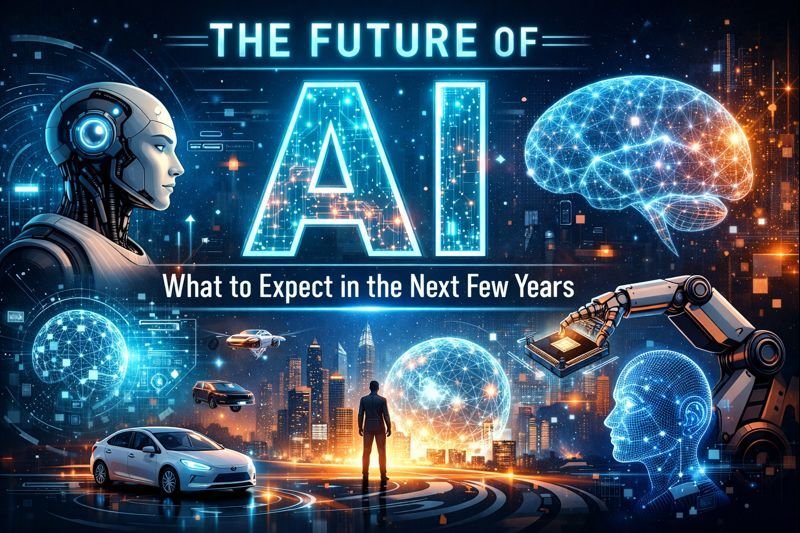

Artificial Intelligence (AI) is no longer a concept limited to science fiction movies or research labs. It has already become an essential part of our daily lives—from smartphone assistants and recommendation systems to advanced medical diagnostics and smart automation. As technology continues to evolve rapidly, the future of AI promises even more powerful, intelligent, and transformative innovations.
In this article, we will explore the future of AI, upcoming trends, real-world applications, benefits, challenges, and what we can realistically expect in the coming years.
What Is Artificial Intelligence?
Artificial Intelligence refers to computer systems designed to perform tasks that normally require human intelligence. These tasks include learning, reasoning, problem-solving, understanding language, recognizing images, and making decisions.
Modern AI systems rely heavily on:
- Machine Learning (ML)
- Deep Learning
- Natural Language Processing (NLP)
- Computer Vision
- Data Analytics
With improvements in computing power and data availability, AI is advancing faster than ever before.
Why the Future of AI Matters
AI is shaping industries, economies, and societies globally. Governments, businesses, and individuals are investing heavily in AI technologies because they improve efficiency, reduce costs, and unlock new possibilities.
Understanding where AI is heading helps:
- Businesses stay competitive
- Students choose future-proof careers
- Developers build smarter applications
- Users adapt to technological change
Key AI Trends in the Coming Years
1. Smarter and More Human-Like AI
Future AI systems will become more context-aware and emotionally intelligent. Instead of giving robotic responses, AI will better understand human emotions, tone, and intent.
Examples include:
- Advanced chatbots with natural conversations
- Virtual assistants that understand mood and preferences
- AI customer support with human-like empathy
This will significantly improve user experience across apps, websites, and services.
2. AI Integration in Everyday Life
AI will be deeply embedded into everyday tools and devices. From smart homes to wearable technology, AI will quietly work in the background to make life easier.
Expected developments:
- Smart homes that predict user needs
- AI-powered fitness and health tracking
- Intelligent smartphones with real-time decision support
AI will shift from being a “feature” to becoming a core system.
3. Growth of AI in Healthcare
Healthcare is one of the most promising fields for AI innovation. In the coming years, AI will play a crucial role in saving lives and improving medical efficiency.
Future applications include:
- Early disease detection using AI imaging
- Personalized treatment plans
- AI-assisted robotic surgeries
- Virtual health assistants for patients
AI can reduce human error and make quality healthcare more accessible worldwide.
4. AI and Automation in Jobs
AI-powered automation will continue to change the job market. While some traditional jobs may decline, many new opportunities will emerge.
AI will:
- Automate repetitive tasks
- Improve productivity in offices and factories
- Create new roles in AI development, data science, and cybersecurity
The future will not be about AI replacing humans—but humans working alongside AI.
5. Rise of Generative AI
Generative AI tools are becoming increasingly popular. These systems can create text, images, videos, music, and even software code.
In the future, generative AI will:
- Help content creators work faster
- Assist developers in coding
- Support marketers with ad copy and designs
- Enable students to learn interactively
However, responsible use and originality will become more important than ever.
AI in Business and Marketing
Businesses will rely heavily on AI to make data-driven decisions. AI can analyze large datasets in seconds, offering insights that humans may miss.
Future benefits for businesses include:
- Personalized marketing campaigns
- Accurate sales forecasting
- Improved customer behavior analysis
- AI-powered chat support
Small businesses will also benefit, as AI tools become more affordable and accessible.
AI and Education Transformation
The education sector is expected to undergo major changes due to AI.
In the coming years:
- Students will get personalized learning paths
- AI tutors will assist with homework and exams
- Teachers will use AI to track student progress
- Online learning platforms will become smarter
AI will make learning more flexible, inclusive, and efficient.
Ethical Challenges of Future AI
While the future of AI is exciting, it also raises serious ethical concerns that must be addressed.
Major challenges include:
- Data privacy and security
- AI bias and fairness
- Job displacement
- Misuse of AI-generated content
Governments and organizations will need strict regulations to ensure AI is used responsibly and ethically.
AI and Cybersecurity
As cyber threats increase, AI will play a key role in digital security.
Future AI systems will:
- Detect threats in real time
- Predict cyberattacks before they happen
- Improve data protection
- Strengthen online privacy
However, hackers may also use AI, making cybersecurity an ongoing battle.
Artificial General Intelligence (AGI): The Big Question
One of the most debated topics is Artificial General Intelligence (AGI)—AI that can think and learn like a human.
While AGI is still theoretical, researchers believe:
- It may take decades to achieve
- It requires advanced ethical control
- It could revolutionize humanity if used wisely
For now, most AI remains narrow AI, designed for specific tasks.
Will AI Replace Humans?
A common fear is that AI will completely replace humans. In reality, AI is a tool—not a replacement for creativity, emotions, and moral judgment.
AI will:
- Assist humans, not dominate them
- Enhance skills, not eliminate intelligence
- Create new opportunities alongside challenges
Those who adapt and learn AI-related skills will thrive in the future.
How to Prepare for the Future of AI
To stay relevant in an AI-driven world, individuals should:
- Learn basic AI and digital skills
- Stay updated with tech trends
- Focus on creativity and problem-solving
- Use AI tools responsibly
Websites like apk4r.org play an important role in educating users about AI tools, apps, and technology trends.
Final Thoughts
The future of AI is full of innovation, opportunity, and responsibility. From healthcare and education to business and entertainment, AI will continue to reshape the world in ways we are only beginning to understand.
While challenges exist, the benefits of AI far outweigh the risks when used ethically and intelligently. The coming years will not just be about smarter machines—but about smarter collaboration between humans and AI.
Staying informed, adaptable, and responsible is the key to thriving in the AI-powered future.